livingwithevan.com

Tag: Heart

  • Two scary steps back

    The short of it: Evan had a seizure early this morning and several more throughout the day.  They are the result of a stroke he had some time ago but not sure when.  He is comfortable, sleeping, and stable.  His brain activity is being monitored continuously for 24-48 hours.  He is NPO again (removed from feeding).  We were scared but it appears he is ok for now. Here is how we got here…

    I received a phone call at 4:45 am from a cardiology fellow.  Overnight calls while your child is in the hospital are never a good thing.  I was so out of it that I didn’t answer the phone, but had my bearings enough to immediately listen to the voicemail he left.  Heart racing, I learned that Evan had a seizure and that he was currently undergoing a CT scan.  Thank God he said the phone number for Moderate Care twice so I could make sure the reality of what I was doing was not some scary dream.

    I called Moderate Care and spoke to nurse practitioner Denise who gave further details on the fellow’s message.  She explained that at around 3 this morning, Evan’s oxygen saturation alarm was going off.  The nurse suspected that perhaps the pulse ox band just came undone (it does happen a lot, but mostly when they are awake and moving or when you are holding them and moving around.)  When she came to check it out, she noticed that Evan looked “mottled and dusky.”  She took a blood gas sample and gave him oxygen.  His pH was a little low, lactate was ok.  After a little while he started doing better and became more responsive.  The plan was to take another blood gas in an hour and see how it looks at that time.

    At 3:30, the nurse went to reposition him and have him sit in his Boppy.  Suddenly he stopped crying and moving, his breathing became sleep apnea like, his head moved to the left, his eyes deviated off to the side.  She said he went “unresponsive” and called the cardiac fellow in to look.  They pulled another blood gas and this had a better pH,  lactate was still ok, white blood count was normal (indicating no infection), hematocrit was fine (indicating good response to transfusion yesterday), and his potassium was a little low so they gave him some extra. There was a concern he was having a seizure so they started him on phenobarbital.  His feeds were turned off and they ordered a CT scan (he can’t get a MRI due to his pacemaker, but I think the CT is the default test).
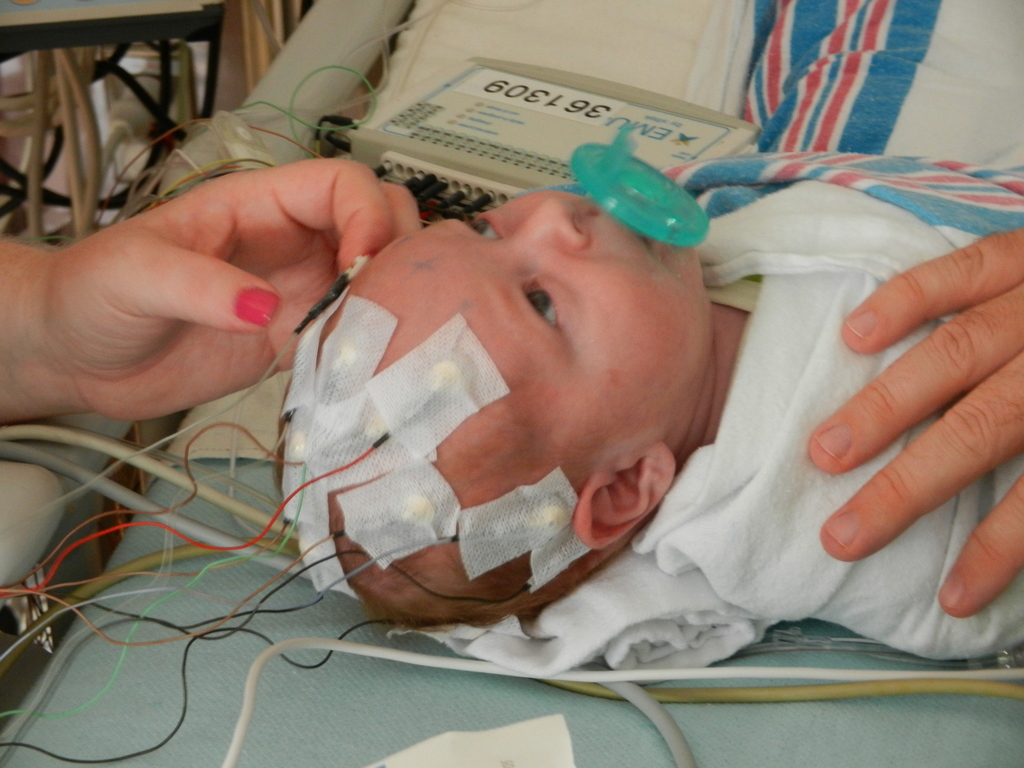
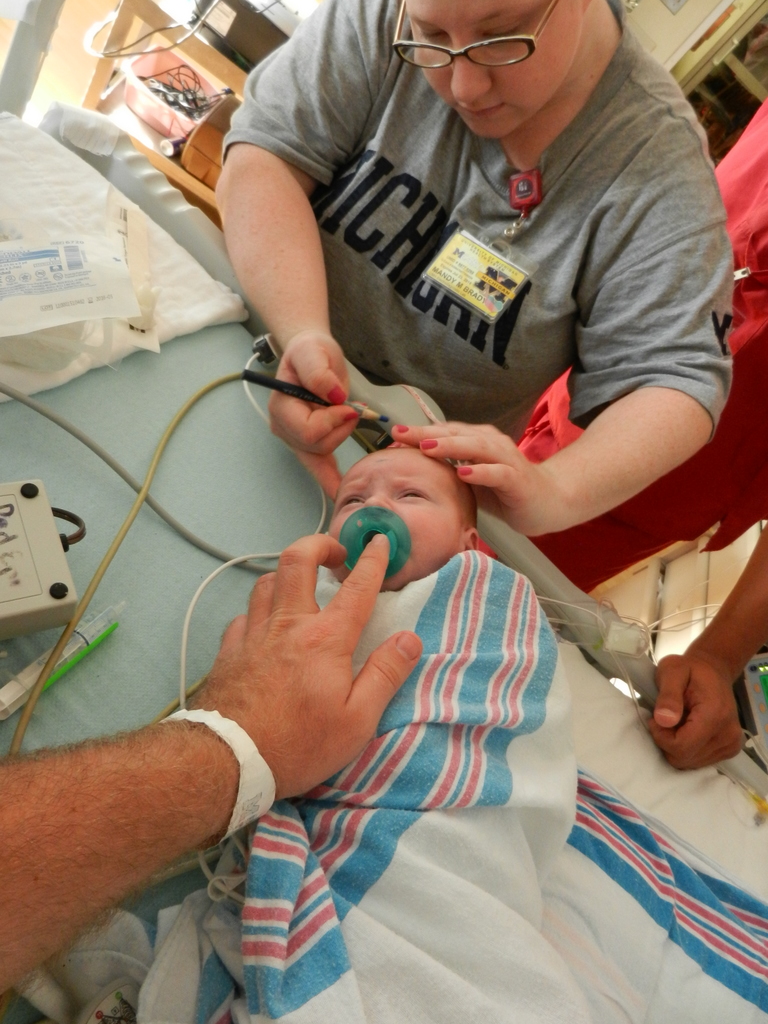
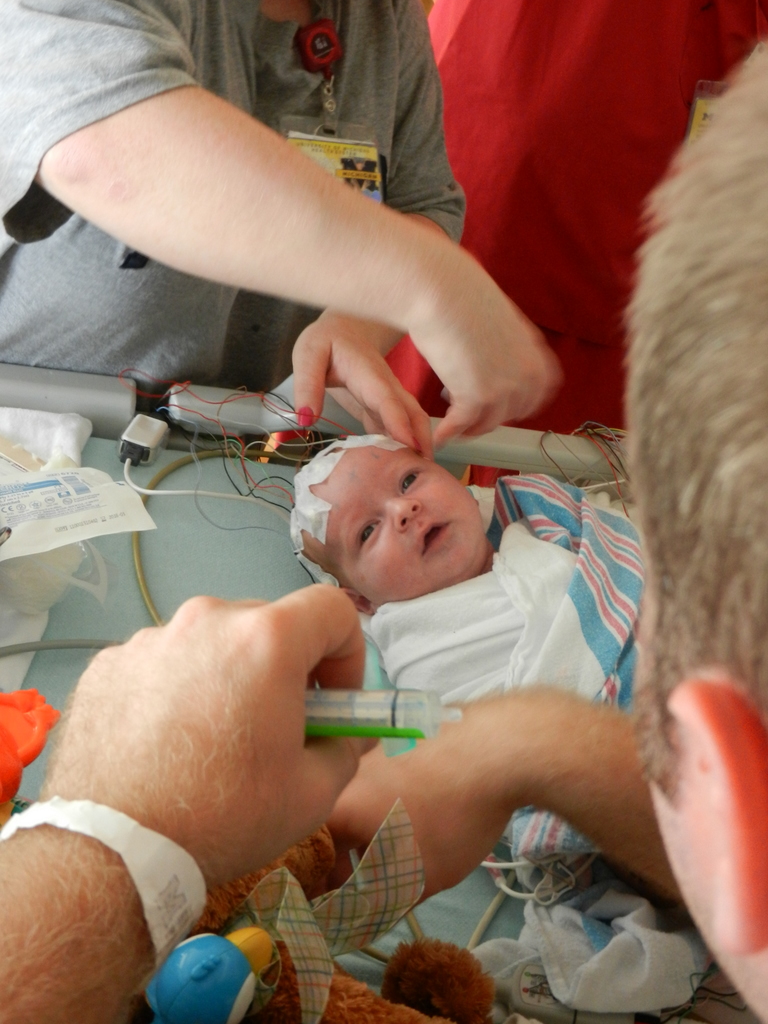
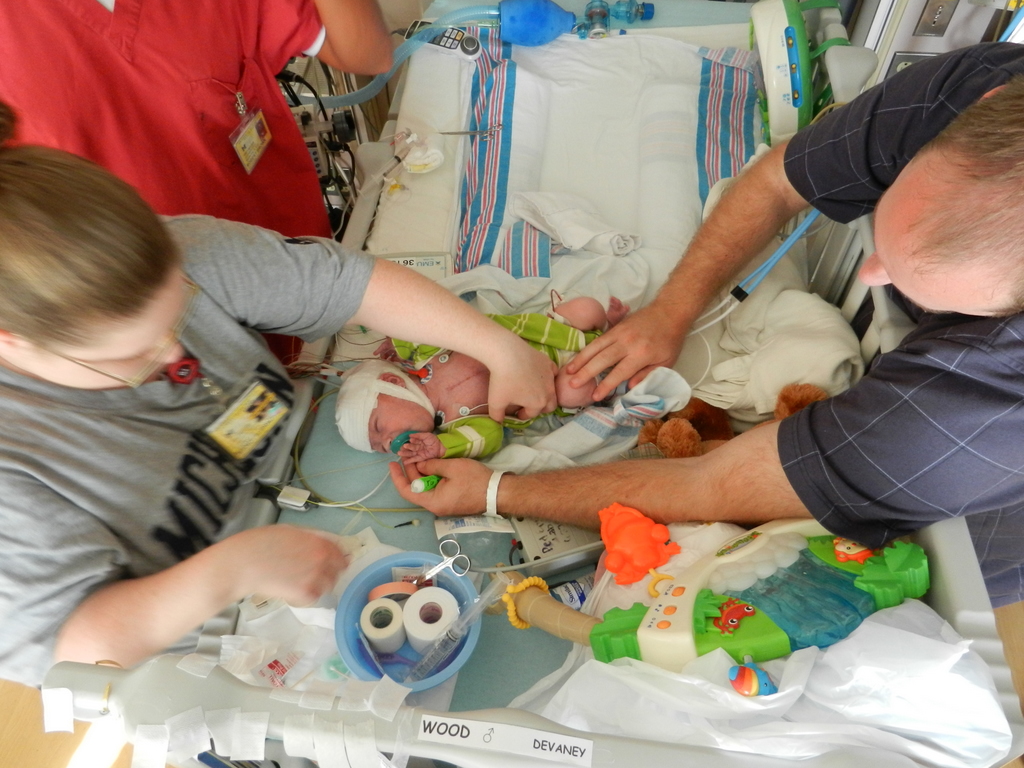
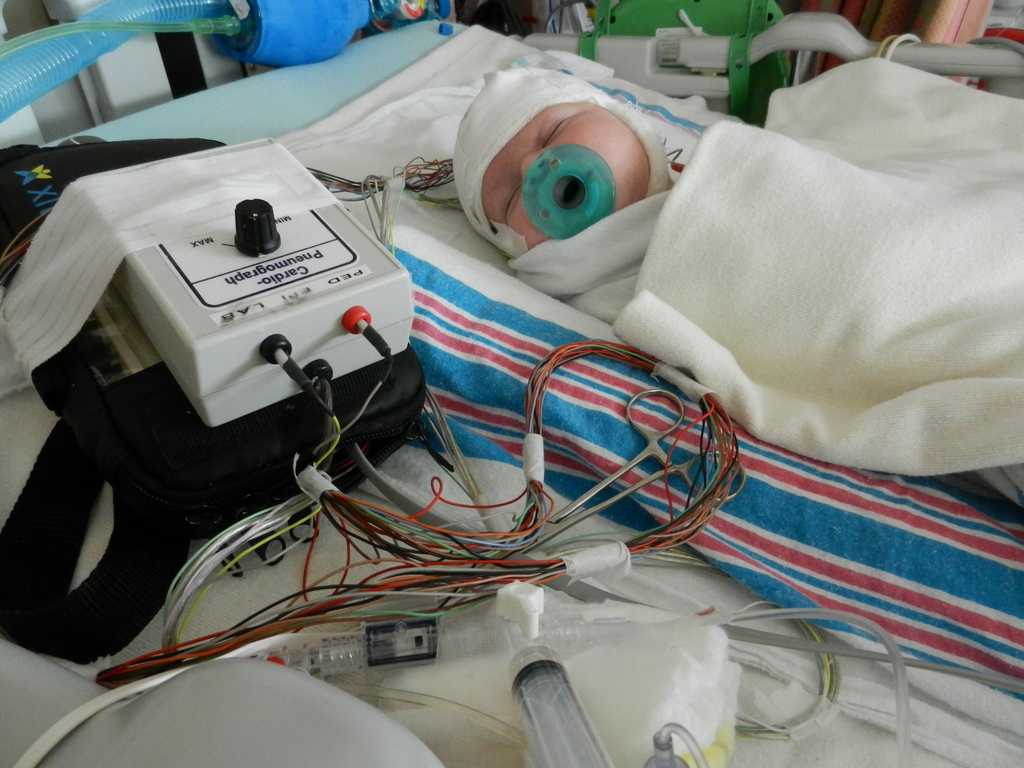
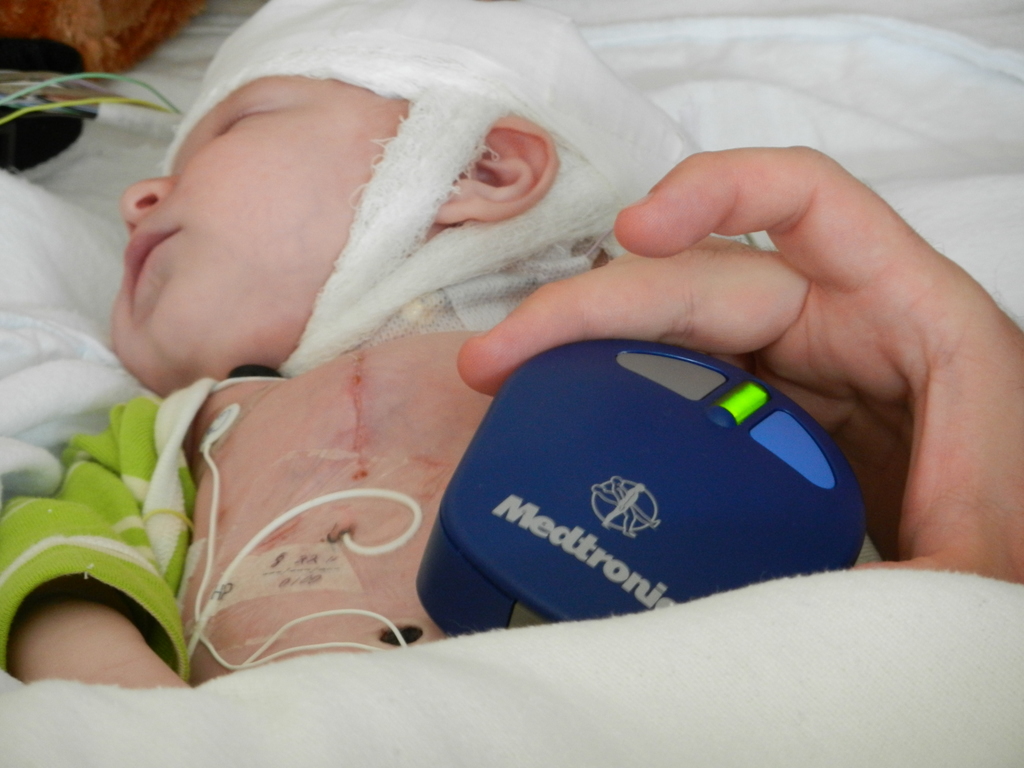
    Evan getting hooked up to the EEG

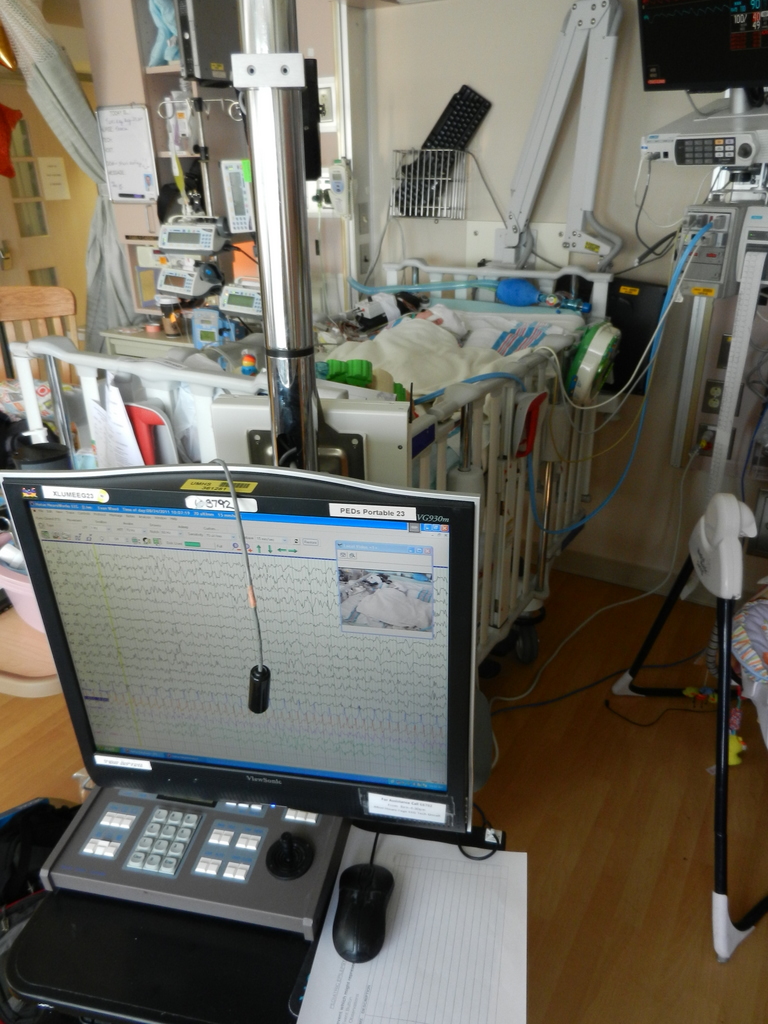
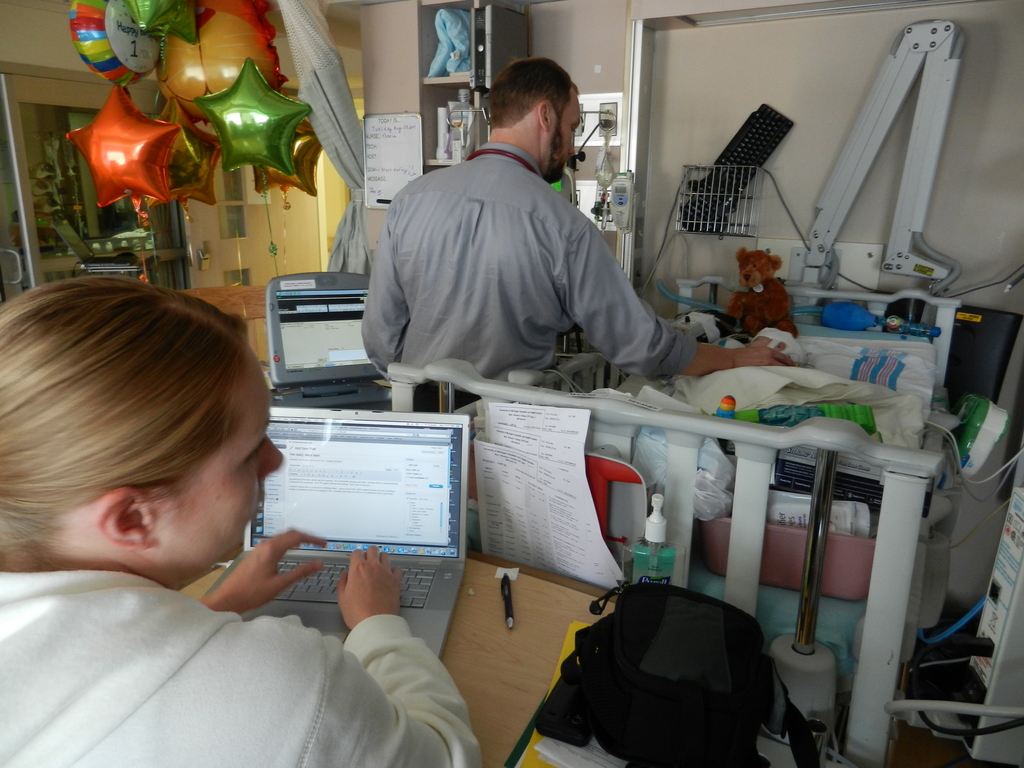
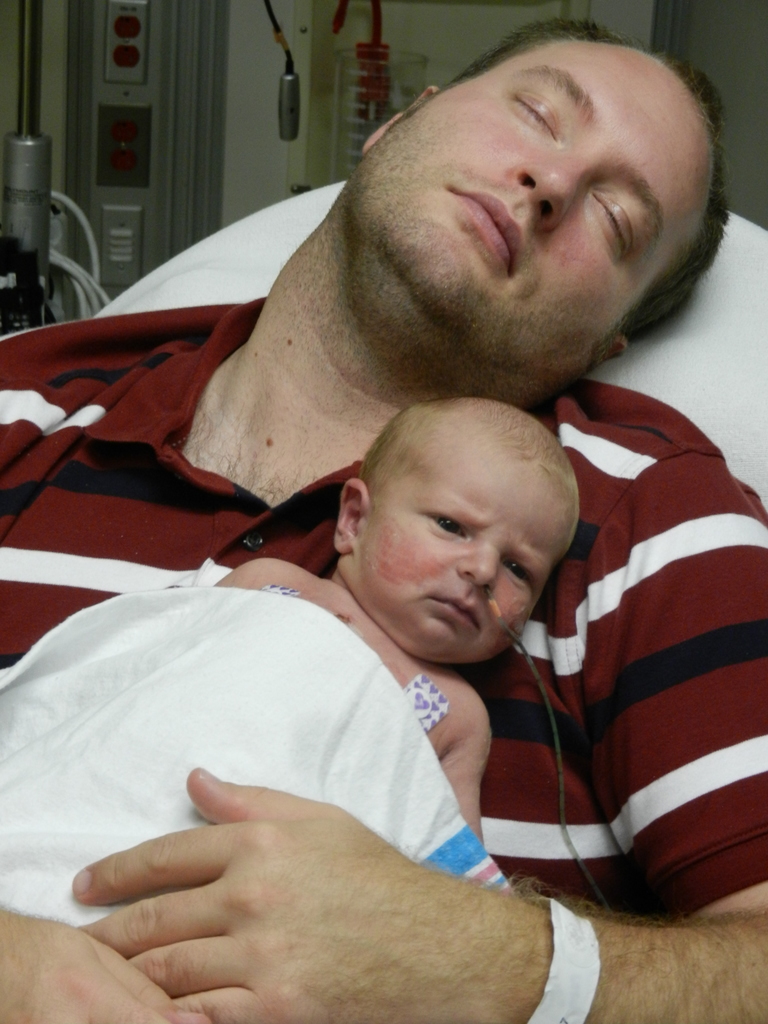
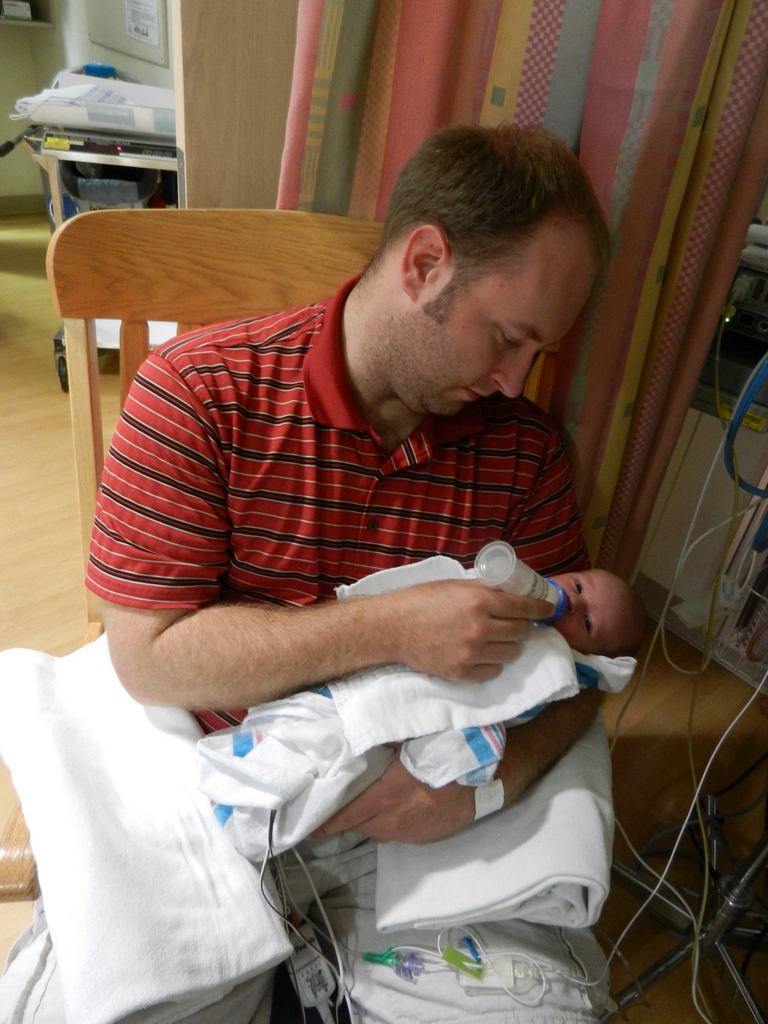
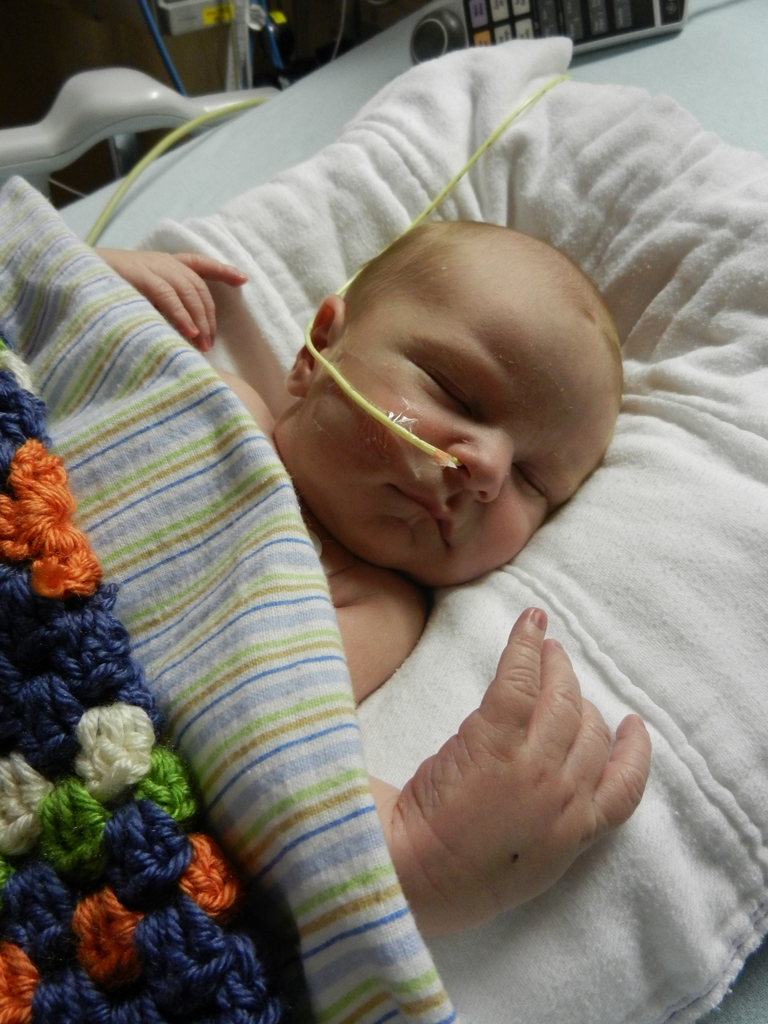
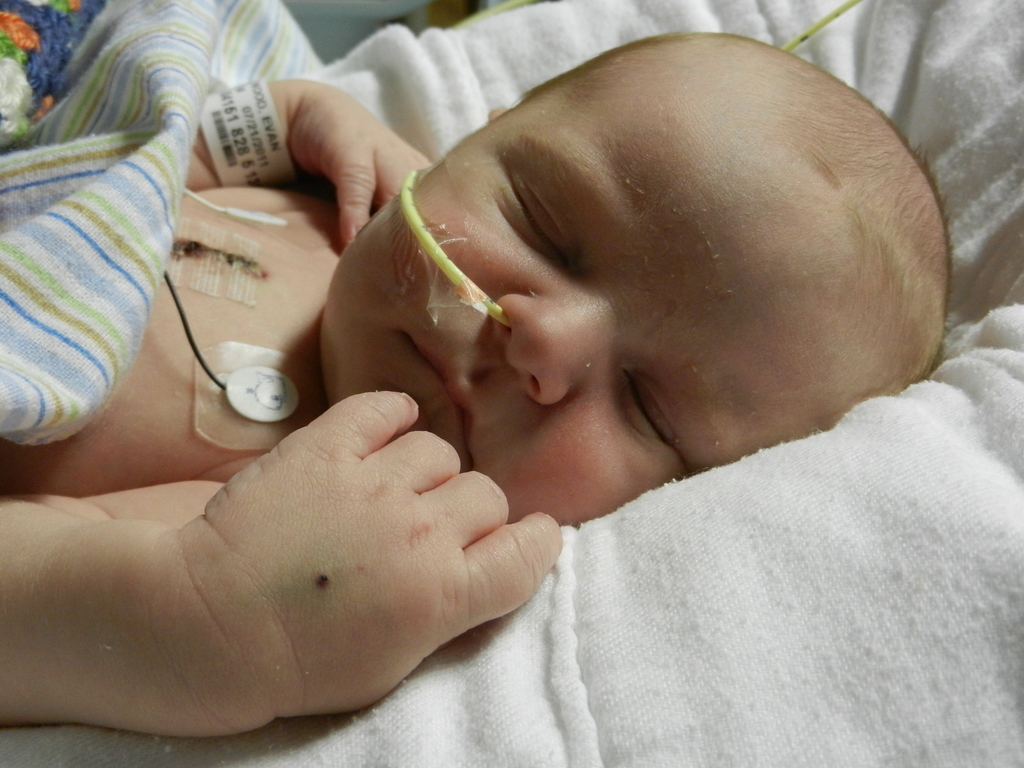
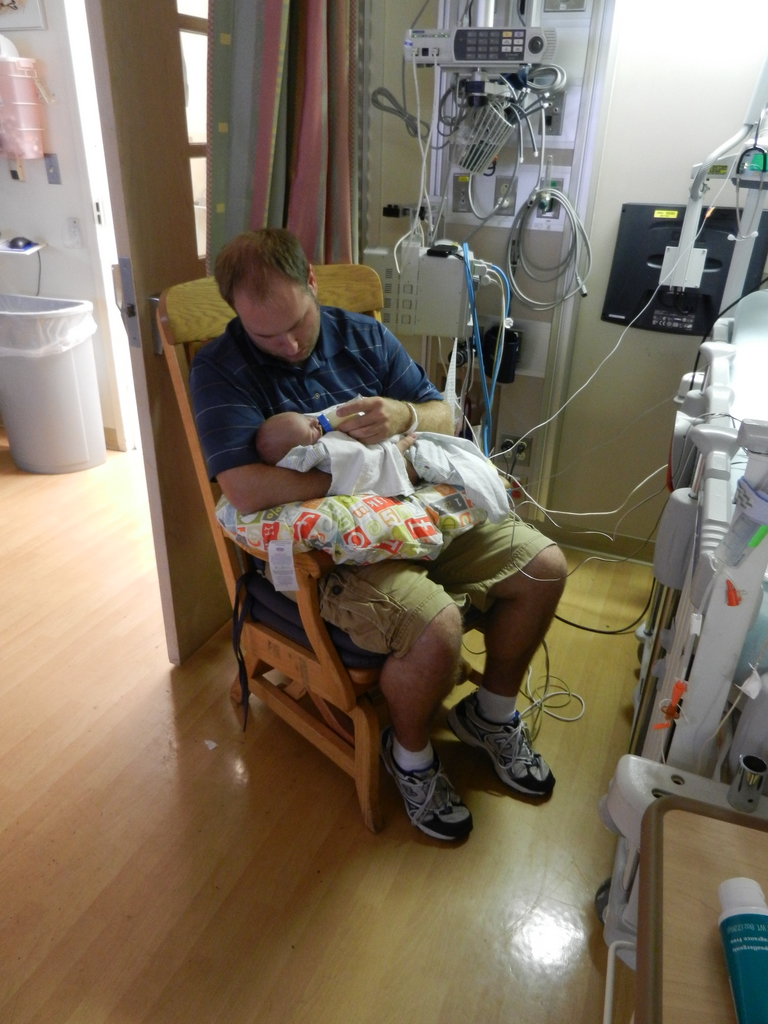
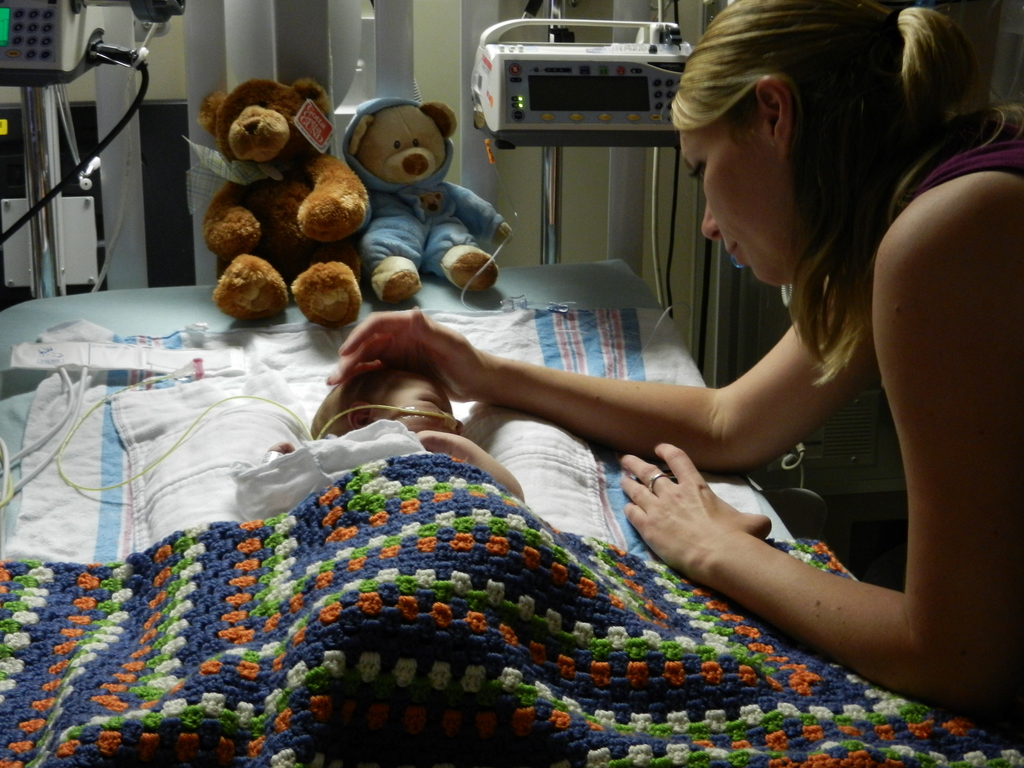
    By the time we got to the hospital at 6:45, Evan was already back from his testing, his birthday balloons detached and bunched together because they had to move him in his bed for the procedure.  He looked completely normal, still had his feeding tube in (which Evan ripped out but that’s for the better considering he is NPO again).  I got to snuggle with him until 8:30 (Dad is feeling sickish and wants to keep some distance) until I had to step out for a bit.  When I came back at 9 people had arrived to place Evan on EEG or Electroencephalogram.  They are going to continuously monitor his brain activity for 24-48 hours, depending on what they see.  Additionally, he is being video and voice recorded as well, so they can see what happens when he has one of these fits.


    Dr. LaPage playing with pacemaker settings

    At 10:30, Dr. LaPage, the electrophysiologist, came by to check Evan’s pacemaker setting.  He has been having low diastolic blood pressures today and they wanted to see if raising his heartrate from 110 to 120 would improve this value.  It didn’t so they left it at 110.  When your heart is in diastole, it is filling with blood before it contracts again.  Your diastolic BP is the lower number.  The fear is that a low diastolic BP may have contributed to his previous cardiac episode on the 16th, so they’ve been monitoring this value as well.  It had normally been in the 40s but it was in the low 20s when they started trying to make adjustments.  Its a teeter-totter balance between pacemaker rates and medications.

    Yet another echo

    An echo was ordered to see if perhaps there is something lingering with his broviac, a catheter placed into his heart during his first surgery.  Perhaps a blood clot formed and traveled to his brain – the nurse suggested.  Wait – blood clot?  That sounds like a stroke.  Thought we were talking about seizure here.  A thorough echo was performed around 1:45 pm.  It was perhaps the clearest images of his heart we had ever seen and we were pestering the technician with structural questions.  “We’re nerdy science people who didn’t go into medicine,” is our explanation.
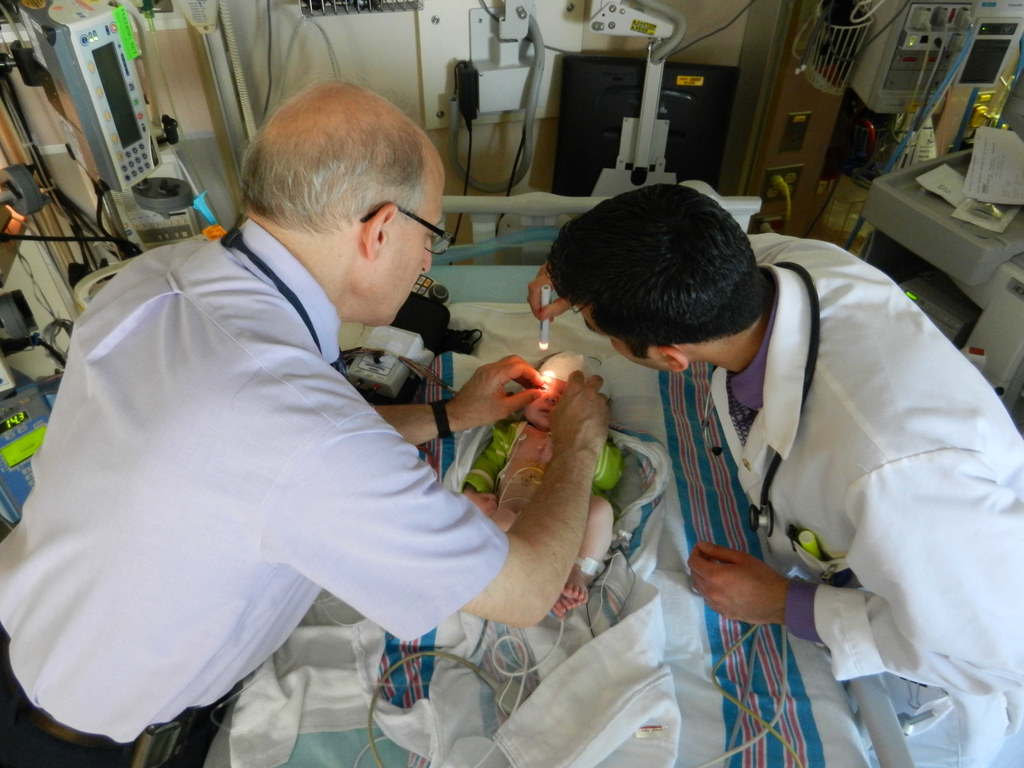
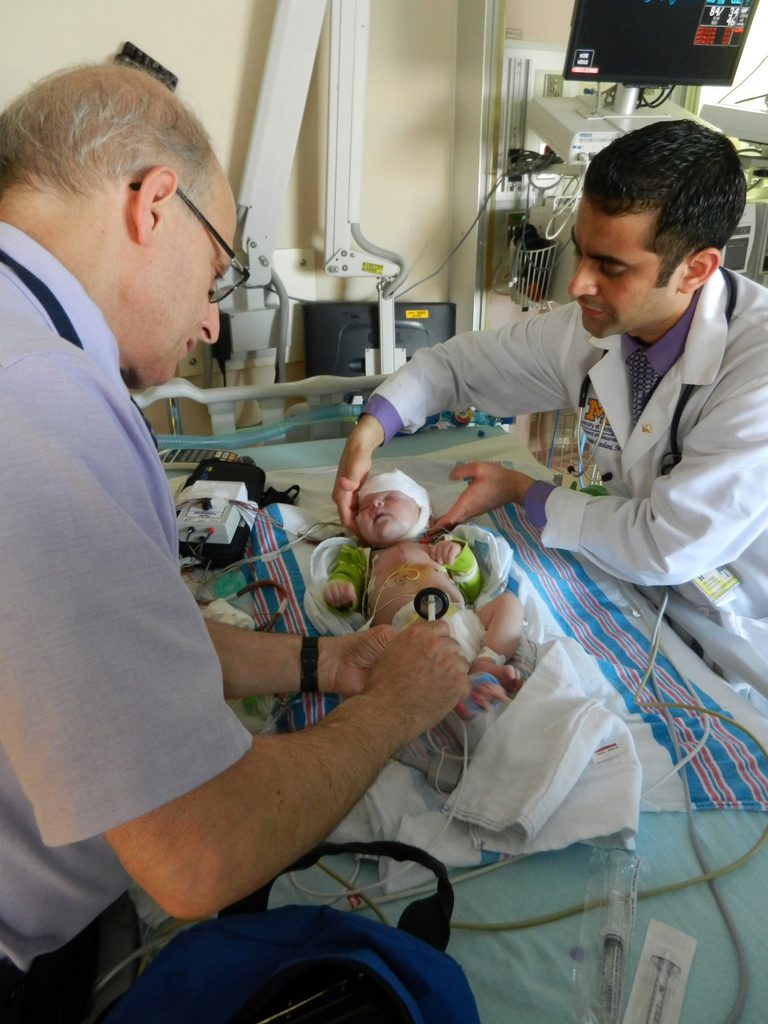
    Dr. Leber and Neurology Fellow exam Evan

    During the echo, the neurologist, Dr. Leber, and a fellow came to talk to us.  During the conversation we talked about the CT scan images and he said, “Do you want to see them?”  Why yes, yes we do.  The majority of the questions resulted from the images.  Evan had a stroke, not yesterday and not when he was born, but sometime.  The doctor did make a comment like it might have happened “a week ago.”  Hmm a week ago… what happened then… Oh that’s right his cardiac incident where he went critical with acidosis and was rushed back to PCTU.  Unfortunately this is the only CT scan we have so we can’t compare to anything, but Evan did have an ultrasound performed on his head the day of his surgery and when looking at those images (although not nearly as easy to see) the doctor did not see any damage at that time.  Damage.  Yes, Evan has some on the left side of his brain.  On the CT images, it looks quite large.
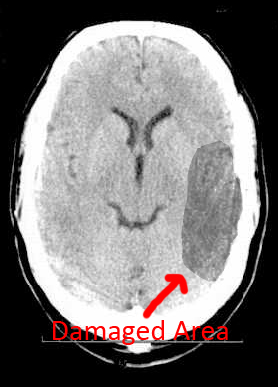
    This isn’t Evan’s brain and I think it is a “normal” adult one but I’m not sure.  I just drew this up for visual reference.  A CT scan is like slices of your body from your toes to your head, so when you look at images of the brain its like looking up someone’s nose.  The left and rights are backwards.  The area of injury permeates through several “slices” of Evan’s brain.  The image I drew would be the damage at its largest.  As you travel the slices toward the top of his head or toward his toes, the area tapers in dimension.  CT scans are gray in color, and the damaged areas turn darker gray.  White is the skull.  Black is water and having some at his age is ok.

    So what will the damage be?  It is hard to say in a baby this young.  If it were you or I, the doctor said we might have trouble feeling our right leg, hand, or right side of our face. We might have trouble with verbal comprehension but not talking.  We might have issues with being able to name/identify our fingers on our hand.  We could have attention problems.  Who knows how this will affect Evan.  His brain is growing so rapidly that maybe no damage will be done.  We don’t even know his handedness yet (I’m thinking southpaw but that’s just me).  There is another area of concern on Evan’s right side as well.  Evidently, as the damaged stroke area gets older, it gets darker in the CT scans.  There is a slightly shaded area on his right side that would be indicative of a separate stroke incident if it turns out to be something.  They are going to check in a week to see if the area darkens and to confirm if there was another stroke (think of the stroke areas as slowing developing polaroid images).  Even when he is 20 a CT scan will show a dark area on his left side from the confirmed stroke region.  It might get smaller, but it should get darker.  The neurologist said that in adults the area retains a brain look but in babies it often disintegrates into a watery slush (?) but couldn’t say why this is so.  Water on the CT scan looks black, so as he ages it should turn into a blackened mass.


    The treatment for now is to continue to monitor the seizures on the EEG.  Seizures can damage the brain cells on the fringes of the stroke region.  Or it can further damage blood supply to the stroke areas thereby causing more damage to previously unaffected areas.  If they see more seizure activity, they will manage that with phenobarbital doses.  We asked about other medications but that is the best option for babies.  In looking up seizure medication lists there are a lot of familiar names.  Phenytoin Sodium anyone?  More of the wait and see game.

    And just after the conclusion of all of this, a nurse drops a package off at Evan’s bedside table.  A gift from the VanEseltine family.  Lots of tears. Many thanks.  Your support, thoughtfulness, and kindness means everything to us and it couldn’t have come at a better time.

    Results of the echo are fine.  There are no indications of a clot on his broviac or associated with the heart.  Maybe there was one and it was missed before and that traveled to his brain?  The neurologist said it is possible that happened before, but this latest echo again did not show any smoking gun.  Good news is because we identified it as a brain issue, there is no need to keep him NPO so they will start feeding him sooner than later, starting over on the complex feeding protocol.

    Please pray for the doctors to have the wisdom to figure all of this out.  If he had 2 separate events then what is the source?  Are there still more potential clots out there?  Could there be more events?  How much longer will the seizures last?
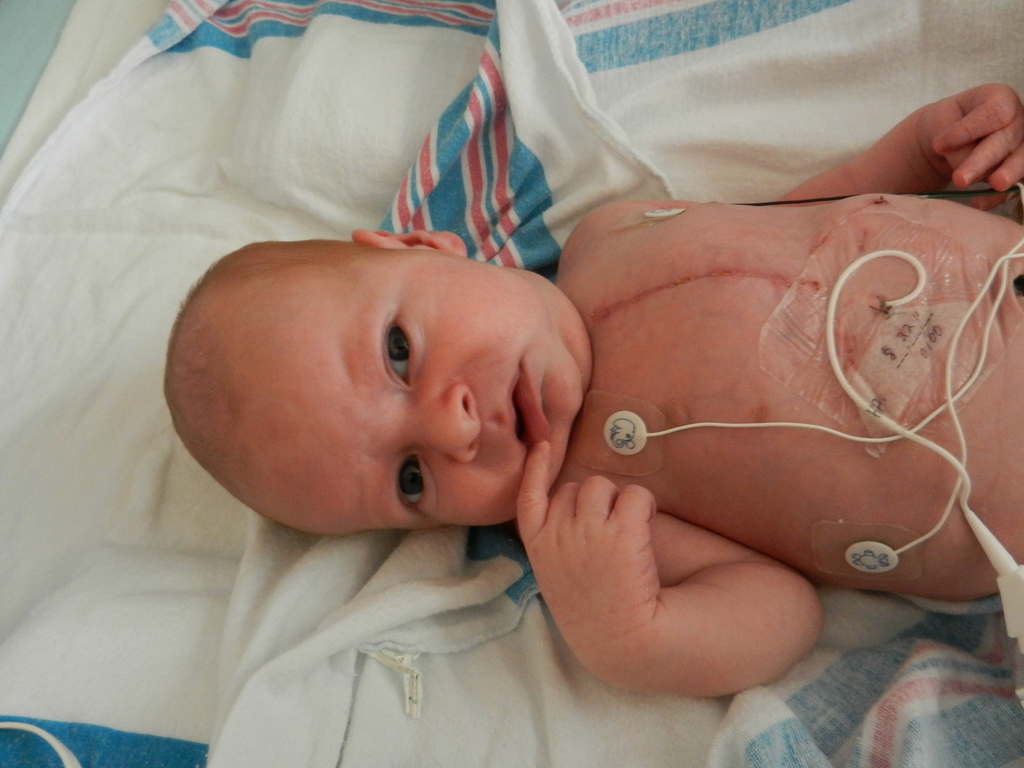
  • Home this weekend??

    This morning Evan had a chest x-ray and everything looks great.  He still has a wet-sounding cough occasionally but it must be residual congestion and is not indicative of any illness.  Good news.

    Evan also had another EKG and visit from his electrophysiologist.  They had originally turned his pacemaker down to 80, but Evan was slightly below that so they turned it down to 70.  Since then he has been pacing on his own.  The docs want to collect 24 hours of his own pacing and they will evaluate the data on Thursday and make a final decision about the pacemaker.

    It was put to us that Evan is in a gray area when it comes to the pacemaker.  With his anatomy, he will need one.  And with a low heartrate, he will need one.  The question is when.  He appears to be tolerating the low rate well.  He does sleep a lot and we aren’t sure if that is because he is a newborn or because of his heart.  He also has feeding issues still but again it might just be due to everything he has been through and not because of his heart.  The question is – although his heartrate is low, is it steady and stable enough to delay installing a pacemaker until his 2nd surgery?  There are risks and benefits to both situations. If they decide to put it in now, the same incision on his chest will have to be opened as well as a new one on his belly.  He’ll have to go back on the ventilator, stay at least overnight in the ICU, and then we would have to work on his feedings all over again.  If there is room, he could have the surgery on Friday, otherwise have it on Monday.  I would guess we’d be here through the end of next week.

    If they decide to hold off, we can essentially leave.  It is the only thing holding us here.  He doesn’t eat well so we need to learn how to take care of his NG tube.  I installed the one he is using now and it did stink to have him cry so much but it really wasn’t that big of a deal.  We can work on his feedings at home just as well (or better) than at the hospital.  We would just need to watch him more carefully and they would teach us those signs.  All he needs is his “little boy” procedure and we could go.  Holy cow.  They would make sure we are well educated before going home.

    Evan is also no longer considered to be in complete heart block (3rd degree heart block).  They said he is more into a 2nd degree heart block with his atrium conduction followed by the ventricles, but that there is a pattern of a growing delay between those two events.  I checked it out and it sounds like Type 1 (Mobitz I/Wenckebach)Here is another source.  When we were discussing his condition the nurse was watching his ECG and noticed that Evan had 4 normal heart beats in a row.  So maybe he will be ok after all.  That’s why they are going to look at the past 24 hours worth of data and also why they get paid the big bucks to make decisions like these.

    I understand better now where the debate was and why they wanted us to wait so long.  I don’t really know how to feel or what to think; I would just be nervous without one but the thought of him not having to undergo another procedure at this point is very appealing.  Just the thought of being able to have a cordless baby makes me giddy with excitement.

  • Setbacks

    Setbacks

    The past few days have been a little rougher for us. Both Bill and I are beginning to feel the strain of doing this routine over and over.  It’s not like we haven’t been enormously blessed and have had such a smooth experience thus far, but we are entering a lull and need to get over this hump for the sake of our sanity.  We’ve heard from other families how they have been here for 4 months, home for 4 days, and then right back in the hospital.  I cannot imagine what it must be like for those long-term families when we’ve only been here for 2 weeks.  We just can’t wait to walk into the next room to pick up our boy free from wires and tubes instead of driving 20 minutes for tethered snuggling sessions.  Thanks for all the words of encouragement – they really help to lift our spirits.

    Evan has been moved to “moderate care” and it is actually quite comfortable and less crowded in there.  He is struggling with eating, which he never really did before.  We think the vent tubes scratched up his mouth and throat and has just made swallowing painful for him.  When bottle feeding, he often makes these horrific gagging faces and looks like he is in pain.  We’ve asked for some pain meds but it will just take time for the tenderness to go away.  In the meantime, he is being tube fed and has been tolerating that well, but he is throwing up more and never did that before.  His food is supplemented to make sure he is getting enough calories.  His metabolism is faster because his heart has to work harder so he needs the extra calories to make sure he gains weight.  Please pray he can take his bottles so we can get rid of his NG tube.

    Evan is still in complete heart block.  On his own, his ventricles do not get the signal from his atrium and therefore do not beat fast enough. His heartrate should be 140-160 beats/min.  Currently, on his own his ventricles pace at 58 beats/min yesterday and 72 beats/min today.  That isn’t going to work.  The doctors will not let him leave the hospital with complete heart block without getting a pacemaker first.  They like to give kids 10-14 days after surgery to give time for swelling and edema to go down.  The docs will make their decision Friday or Monday and schedule it for next week.  It will probably give us an additional 5ish days in the hospital. 
    Dr. Hirsch stopped by today to talk to us about it and she actually said that he had his own beat in the OR and it wasn’t until bringing him to the ICU that he developed heart block.  So there is hope it can come back.  Please pray for this.

    Evan continues to poop like a champ but now he has diaper rash.  Poor buddy!  We now slather a super thick cream on his buns so
    hopefully it will go away soon.  And daddy fell victim to the first pee spray yesterday.  Frankly I’m surprised it has taken this long.

    Maybe it is just me because I am new to this or maybe it is a change that happens between 1 and 2 weeks old, but lately when looking at Evan his eyes cross pretty frequently.  Maybe his vision is improving and he is trying to focus??  Fellow parents, is this normal?


  • Quick Update #2

    Short and sweet – We just got briefed on Evan’s progress and so far everything is looking great!  Big boy is doing awesome and continues to kick ass in the OR!

    Dr. Hirsch is now working on installing the BT shunt that will connect the subclavian artery to his pulmonary atery.  She is also going to install an IV that will lead directly to his heart to improve administration of medications as well as monitor his blood pressure continuously.  It will stick out of his skin but will be better for him after the surgery. She has already completed the Damus-Kaye-Stansel (DKS) procedure, which combines his pulmonary artery and aorta.  She also whittled away at his atrial septal defect (ASD) to make sure it is sufficiently large that it will not close on its own.  She has also tied off his patent ductus arteriosus (PDA) because it is not needed for blood flow to the lungs, now that he has a shunt.

    When the anesthesiologist was carrying Evan away and Will and I started crying she said, “I know… I have your heart in my arms.  I promise we will take good care of him.”  I have no doubt they are and that he will recover beautifully.  Everyone here is awesome and we are so fortunate to have such a facility close to home.  This is the first step to going home and hopefully that is only a couple weeks away. 🙂

  • University Of Michigan Appt #2

    University Of Michigan Appt #2


    We had our second appointment at the University of Michigan on June 10th. This appointment put little Evan at 34 weeks and 5 days.

    We started the day off with a fetal echocardiogram with Jane. Evan was awake and ready to play. He was rolling over and just moving a lot in general making it hard for Jane to get all the information she needed. It took a while but eventually she had measured everything she needed. Dr. Owens was looking at the images in another room and came in to talk to us as well as take some images of her own. She said that everything looked great and there were no unexpected surprises. Yay! Evan will not have another echo done until after he’s born at which time they will do a very extensive echo and gather all the details needed to plan his surgeries.

    We were approached about a research study and asked if we would like to take part in it. Connie came up to talk to us about the study and see if we were interested. The study is led by Dr. Mark Russell which if you read the last U of M post was the first doctor we met with at U of M that thoroughly explained Evan’s condition to us and what needed to happen to fix his heart. The study focuses on children born with heart defects and need open heart surgery. Some children have more difficulty recovering from the procedures than others despite all the steps taken to protect the tissues from injury. The purpose of the study is to see if there are any inherited factors that help determine the ability of each child to tolerate the stress of surgery. Our only involvement in the study is to allow them to take a teaspoon of Evan’s blood (which would happen at the first surgery when he is sedated) which they will use to look at his genetic markers compared to other babies. Then we give consent for the research team to get copies of Evan’s follow up appointments so they can track how he’s doing up until 6 years old. The team is make up of several pediatric cardiologists, an anesthesiologist, surgeon, and bio-statistician and they are looking to have 1000+ patients in the study. Participation in this study is a no-brainer for us. I hope that the information that they gather can help other children down the road.

    We talked to the Barb, the social worker about housing in Ann Arbor while we are there. We really need to get on the ball with this. We still have not booked anything and it’s only a month away. Barb is supposed to be getting us some information on corporate apartments. We really don’t want to stay in a hotel type room for that period of time. I’m really going to focus on this next week.

    We met with an OB/GYN for a pretty standard appointment. We didn’t really get anything out of meeting with her but <shrug> that’s ok. She gave us some information about the U of M triage phone, we talked about the group B strep test that every mom has to have before birth, etc. We asked about immunizations for people in contact with Evan and she echoed the need for the pertussis vaccine (whooping cough). This is the Tdap (Tetanus, Diphtheria, Pertussis) vaccine that everyone should have a booster of every 10 years. If you have not had one, get one, it’s deadly, especially to small children. It’s highly contagious and people can transmit the bacteria for 2 weeks after they begin coughing. The illness can last ~6weeks.

    At 3pm we had an ultrasound with Cathy… Measurement! This is what we’ve been waiting for! It was great. Evan was up to 5lb 8 oz. Yay!

    Next appointment at U of M at 38 weeks.


  • U of M appointments

    U of M appointments

    Last Thursday we had our all-day appointment at U of M.  We weren’t sure what to expect but hoped to come away with a better understanding of the process we are going through and the facility that will become our second home.  It didn’t take too long to get there – about 1.5 hours – but I can easily see how construction, traffic, or an accident could significantly change that timeframe.  I-94 is not fun or commuter friendly.

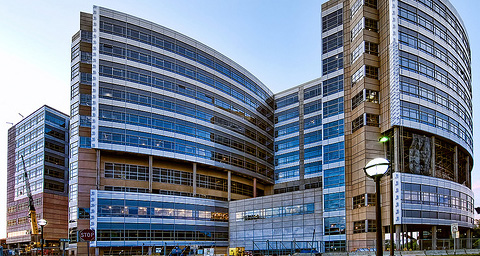
    The hospital was easy enough to find, and you have to pay for parking which I think stinks considering we’ll be spending how much money for services there??  I mean it is cheap (if you don’t lose your ticket…)  Unfortunately we will not be in the new women and children’s hospital, but we should be over there for his other surgeries.  Too bad, because it looks and sounds lovely.  The old hospital… well… let’s just say the conditions don’t exactly match the caliber of care provided there.

    8:00 am – Cardiologist appointment

    Our first appointment was to receive our second echocardiogram at the Pediatric Cardiology center in Mott Children’s Hospital.  We got to meet with Kathy, one of the nurses and the one who would help guide us through our day.  I was especially looking forward to this appointment as previously there was a slight discrepancy in what his condition might actually be, and this was an opportunity to have another expert provide their opinion.  The tech was very thorough, albeit a bit fidgity and fussy at times, probably due to a lack of angle cooperation by baby tricky.  We met with Dr. Russell who confirmed the diagnosis of Dr. Fountain-Dommer.  He actually gave her some kudos and spoke very well of her for catching this different condition and not going along with the suspected condition of HLHS.  We asked him to point out some structures on the echo and he happily answered all of our questions.

    What we learned:

    • UofM sees about 50-60 single-ventricle cases a year, so about 1 a week.  About 30 are HLHS.  There are a decent amount of TA cases, TA/l-TGA is still rarely seen.
    • The first surgery, the Norwood procedure, will happen within the first week of life
    • If we need to have any specialized equipment at home, it might be a feeding pump.  Hopefully he will pick up feeding, but if needed he will continue to be tube fed.  They will teach us CPR and how to insert his tube before we are discharged.
    • At minimum, Evan will be on baby aspirin and diuretics – hopefully that will be it!


    9:30 – OB/GYN appointment

    We shuffled off to the Taubmann center for our next appointment.  I had no idea really what this appointment was for, other than to load my information into the database.  We did come prepared with questions, particularly because we felt that these were the individuals who would be able to give us the best birthing information.  We met with Dr. Mozurkewich and again she answered all of our questions.  We also talked with a nurse who gave us information on the 3rd trimester as well as a pretty nice birthing book.  most of our time in this appointment was spent waiting, but that was ok because we could go over the info received at the cardio appointment.

    What we learned:

    • Cesarian births are not encouraged, and there is a strong leaning toward natural childbirth (I use natural to mean vaginal).  The thinking is that 1) he is still connected to me until they cut the cord so he should be ok 2) the compression of giving birth helps to free fluids from the lungs and promote circulation.  Obviously if a c-section is needed it is done, but they encourage one to try.
    • Whether we induce or not depends on personal preferences and the opinions of the cardiology group.  They do not see harm in waiting for nature to take its course.  First babies usually take a little while, so even the drive from Kzoo does not make  them lean one way or another.
    • Whomever is on call will be delivering, so we might meet the particular doctor before hand or maybe just that day
    • I  will deliver in an operating room (more detail about that later)
    • Episiotomies are not commonly performed
    • If I want to have a medicine-free birth, that’s ok.  They will probably add an IV port just in case
    • With a natural birth, as many people as I want (realistically) can be in the room.  With a c-section, only Will would be in the room with me
    • I’m glad we brought a backpack to hold all of our paperwork!


    11:00 – Social Worker appointment

    We were supposed to meet with our surgeon next, but since we were  meeting her between surgeries, we needed to be a bit flexible with our time.  We went back to the Pediatric Cardiology center, paged Kathy the nurse, and she got a hold of Barb, a social worker with the department of pediatric cardiology.  She has worked there for 22 years and holds a wealth of information

    What we learned:

    • If we want to have him baptized, blessed, or christened before surgery we can do so.  The hospital chaplains can provide the services or we can have our own person come in.  Just thinking of it makes me cry but something we will want to do.
    • We will deliver in the high-risk  side of the Woman’s East birthing center.  We will do the great deal of our labor in the room, and when the time  comes to get the show on the road, I will be wheeled down the hall (~100 ft or so?) to an operating room.  It doesn’t really look like an operating room like you see on TV, but it is more important that adjacent to the room there is a newborn crash room.  It holds every kind of equipment they might need in case  something goes wrong.  He will be whisked away into there after birth and if he’s pink and breathing ok, they will bring him back to be with us  for a few minutes.  Hopefully this is the case because it is extraordinarily important to me to get pictures of him with no scar and not hooked up to anything.  Evan will have tubes and wires for the next 4-5 weeks, so images of him looking like every other normal baby will be  awesome.
    • He will spend the next week-ish (until his surgery) in the NICU.  Hopefully he will be a big ole fat turkey baby and will look out of place next to those skinny babies.  We pray that his breathing will be ok and he won’t need to be on a ventilator, because if he is, then we won’t be able to hold him.  And I don’t know about you but not being able to hold your  new baby is not something I am prepared to deal with.
    • There are 40 NICU beds (10 beds in 4 rooms) and only 2 people can be bedside at a time.  Anyone can visit but they MUST be healthy.
    • While in the NICU, we can bring something that smells like us but most comforting to him would be recordings of our voices, like if we read books to him.  That is the sense he is most used to at that point.
    • Surgery will be on the 5th floor and afterward he will stay in the cardiac NICU which only has 15 beds but is specifically monitored by cardiologists.  He’ll be there 1-2 weeks I am thinking.  100% of babies are on ventilators after surgery, so we will only be able to touch his little hands and such.  This might not be a bad thing because I am not sure I would want to hold him because he will be so delicate.  Sometimes the chest is left open and there are quite a few tubes to drain fluid.  Here is an image of a Facebook friend’s little baby after this surgery and we would anticipate Evan to look pretty similar.  Warning – it is a little tough to look at.  And double warning – this is the sweet little baby that passed away and I mentioned in a previous post, so  don’t read the blog if you don’t want to cry.
    • Once he is off the vent and tubes start to come out, he can transition back to the NICU or bypass that entirely and go to the general care recovery rooms.  While in these rooms, we’ll be able to do real parent things like change diapers and feed him.  Gasp!  He will have been tube fed up to this point and then it is on to bottles and then breastfeeding.  Bottles are easier on weaker babies, so they like to start with those.  He will be staying in the room and there is a larger bed for parents to stay in too.  They encourage parents to stay in the room by switching on and off.  Here we will learn CPR, how to put in his feeding tube, and how to take care of his wounds.  We’ll be there for about 2 weeks and can then go home.   Yay!
    • He will have his “little boy” procedure after his surgery, while in the general care room.  Like he doesn’t have enough problems already, right?  Poor fella…
    • They have pumping rooms and freezer storage system to keep track of everything so we can make sure Evan gets the most nutrition, even if he gets it via tube
    • We may be eligible for Children’s Special Healthcare Services or 30-day Medicaid services as well
    • Mott is billed under the U of M health system


    11:45 – Meeting with the surgeon

    This occurred during our conversation with Barb as the doctor became available.  Her name is Dr. Jennifer Hirsch and she looks way young (we guestimate she should be ~42ish but easily looks 10 yrs younger), is very beautiful (her official doctor pic does not do her justice), very smart (she went to Harvard people), and was extremely kind and open to talk to.  She was the first person at U of M to ask if our son had a name and  referred to him as Evan when talking about him.  Evan will die without any surgical intervention so it was surreal to meet the person who is going to save his life.  We cried after she left.  It is a bit overwhelming.

    Things we learned:

    • 75% of babies will live to have the  2nd surgery at 4-6 months.  Not that this was new info, but it confirmed some of the numbers we had read about online.
    • The timing of the 2nd surgery will depend on how fast he is growing.  In the 1st surgery, they will put a BT shunt to reduce bloodflow to his lungs (otherwise too much would go there and not enough would go to the body).  They have to guesstimate the shunt size, and essentially when he outgrows this is when he has the 2nd surgery.  If born on July 17, that would give a November-January timeframe.  I’m not  excited about it being holiday season and illness season to have open-heart surgery.  It also makes it trickier to know when to take time off of work, but we’ll just have to play it by ear.
    • For the 2nd surgery, they detach the superior vena cava and attach it passively to the pulmonary artery (this is the big vein coming from the head/arm/upper body region).  They do this one first (instead of the inferior vena cava which is the big vein returning from the lower body) because babies are all head and it will provide the most relief for the heart.  Once kids become mobile and start to use their lower bodies more (18-36 months old) then they have the 3rd surgery to attach the body vein passively to the pulmonary arteries.
    • Evan will be cyanotic until the 3rd surgery (blood oxygen level below 90%) but will look like kids when they get out of the bath – a little blue to the lips and fingertips.
    • She gave us her email and encouraged us to send her any questions or comments we might have


    After this we hauled ass to go get something to eat.  It’s like they didn’t schedule a time for this or something… very weird…


    1:30 – Genetic Counseling appointment

    We had to have this appointment even though we received genetic counseling at Bronson.  It’s just part of the packaged deal.  This was at the Perinatal Assessment Center also in Mott.  It was nice to be able to talk to someone again if we did have questions.  They offered an amnio again and we declined.  Given that no other health issues have come up on ultrasounds we feel the likelihood of him having any genetic condition to be low.


    2:30 – Ultrasound appointment

    Yay more pictures of baby boy!  The tech was lovely and from Kzoo.  She said everything was looking good except he was being a little uncooperative and tricky.  Afterward, we met with Dr. Treadwell and she confirmed that she did not have any concerns for any other conditions to be present.  A nurse, Liz, gave us a tour after the US and showed us the birthing areas and NICU on the 4th floor.  It was very nice of her to take the time to help us get a sense of things, although I think we will want a more general tour too in the future.

    What we learned:

    • Evan weighs about 3 lbs@ 28 weeks, putting him in the 59th percentile.  Definitely thought he would be bigger but I think he will have plenty of time to get huuuge.
    • Evan is very limber.  He was sitting breech, I think footlong breech, because he was holding one foot right up to his face.  I’m not sure where the other one was?


    We are going to go back June 10th for another cardio, OB, and ultrasound appointment.  Until then, we have our regular appointment at Bronson in a couple weeks.  We will probably go to U of M 1 more time after that prior to delivery, but otherwise we’ll just do some co-care with Bronson.


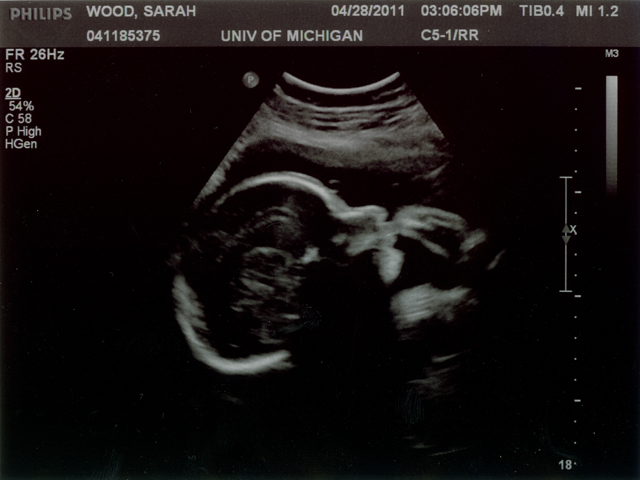
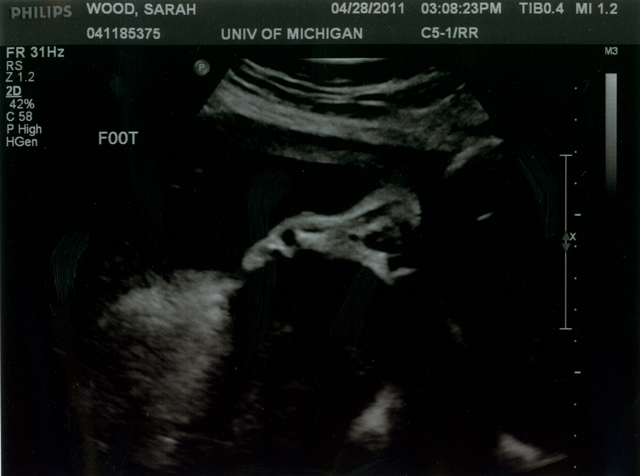
    Here is a profile.  I guess that is some brain development, so that looks cool.  The smudge by his face is a foot I think.


    This is the foot that kept getting in the way!


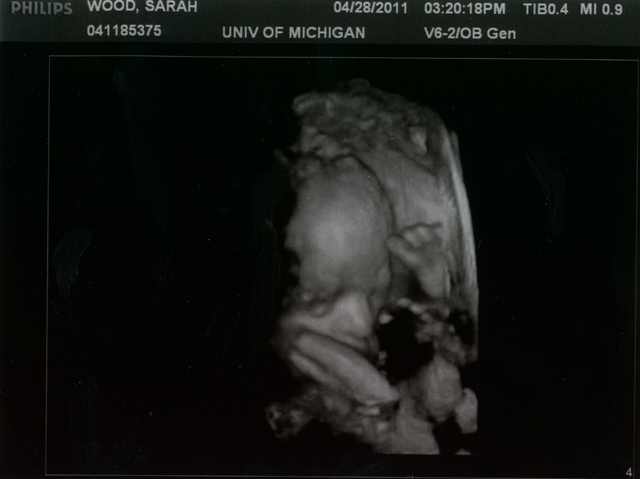
    They tried to do a 3-D image but of course it  looks all crazy.  I only share because I love those toes!   The other smudge by his face must be an arm or something.


  • Normal Heart vs. Evan’s Heart

    Normal Heart vs. Evan’s Heart

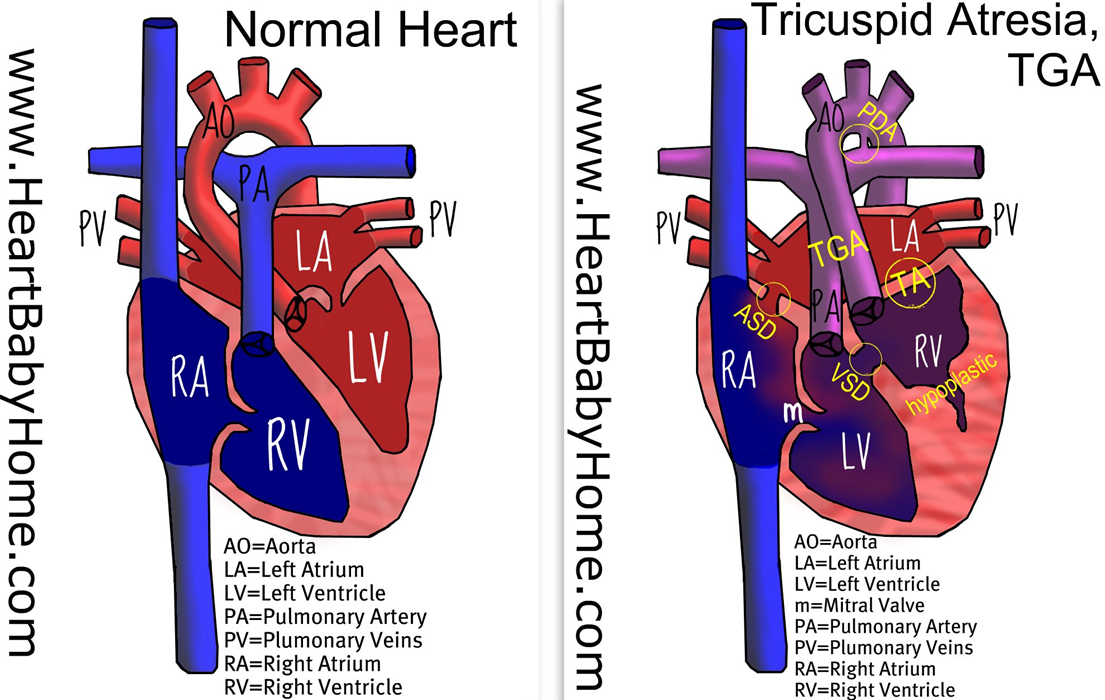
    I created a new page to describe the differences between a normal heart and one like Evan’s… you can see it under the menu item Evan’s Condition or by clicking here.


  • Fetal Echocardiogram today…

    Fetal Echocardiogram today…

    We went to the cardiologist today and were officially diagnosed (previous was best guess by radiologist, OB, etc) Evan does indeed have a congenital heart defect but it’s not hypoplastic left heart syndrome. He has a much more rare (1 in 25,000) defect called Tricuspid Atresia with Left Transposition. It’s two parts, 1) There is no tricuspid valve and 2) His left and right ventricle are transposed, meaning on opposite sides.

    I’ll be updating the website with new information but it’s going to take a little while as this is much more rare and hard to find information about.

    Important to note… this still means lots of open heart surgery for our young one, but it sounds like although it’s more rare, it has a little less risk. Stay tuned.